
Finding the best touchscreen laptops shouldn’t feel like a chore. You deserve a responsive display that transforms how you work and play. Stop fighting with a clunky mouse and unlock your creative potential with a device that feels like magic. Whether you need a versatile 2-in-1 device or a sleek powerhouse, we’ve curated the perfect match for your unique lifestyle. Here are our top picks to help you work smarter today.
Contents
20 Best Touchscreen Laptops
1. HP Pavilion x360 2-in-1

The HP Pavilion x360 is a useful 2-in-1 that makes things easy. It has a 14-inch Full HD multi-touch IPS display, a smooth 360° hinge, and Windows 11 Home for everyday work. It has an Intel Iris Xe graphics card and an Intel Core i5-1235U processor from the 12th generation. It also has 8GB of DDR4 RAM and a fast 512GB PCIe NVMe SSD, so boot-ups and app launches are quick. You also get Wi-Fi 6E, Bang & Olufsen-tuned twin speakers, a brilliant 5MP camera with a shutter, and a fingerprint reader. This is a wonderful deal if you want a touchscreen that works with a lot of different devices without spending too much.
2. ASUS Zenbook 14 OLED

The Zenbook 14 OLED is a great choice if you want a very portable touchscreen that still feels high-end. The 14-inch WUXGA (1920×1200) multi-touch display has a modern 16:10 aspect ratio, covers 100% DCI-P3 for rich, realistic colors, and has a brightness of 500 nits. An AMD Ryzen 7 8840HS (up to 5.1GHz) with Radeon graphics, 16GB DDR5, and a 512GB PCIe NVMe SSD give it the power it needs to run smoothly. It has a lot of handy extras, such Wi-Fi 6E, USB4/USB-C with DisplayPort/Power Delivery, HDMI 2.1, a backlit keyboard, and a 1080p camera with a privacy shutter. It’s great for business and travel.
3. Microsoft Surface Pro

The Surface Pro is for folks who want a real PC that can also be a tablet right away. The 2024 model has a 13-inch OLED touchscreen display and runs Windows 11 as a Copilot+ PC. It is powered by a Snapdragon X Elite (12-core) processor. It has 16GB of RAM and 256GB of storage, so it can handle office work, web surfing, streaming, and creative programs quickly while still being thin and easy to carry. The biggest benefit is that you can use it anyway you want: tap, swipe, sketch, or dock it into a more traditional configuration when you need to. This shape is hard to beat if your work changes every hour.
4. Microsoft Surface Laptop

The Surface Laptop (2024) is a clean, professional choice that feels more like a classic laptop but with modern AI capabilities. It has a 13.8-inch touchscreen display and runs Windows 11 and Copilot+ PC. A Snapdragon X Plus (10-core) CPU powers it. With 16GB of RAM and a 256GB SSD, this setup is great for productivity, light creative work, and web-heavy routines that last all day. The touchscreen makes it easy to scroll, write notes, or give a presentation without stopping your flow, and the simple design fits well in a bag. This is a fantastic choice if you want Windows to be as simple as a MacBook.
5. Microsoft Surface Laptop Studio 2

The Surface Laptop Studio 2 is made for creators who require a powerful and flexible machine. You get a big 14.4-inch touchscreen display, an Intel Core i7 processor, 16GB of RAM, and a 512GB SSD. You also get an NVIDIA GeForce RTX 4050 GPU, which makes creative apps run faster and games run more smoothly. The dynamic form factor is the best part. It can change from laptop mode to a forward “stage” posture and then to a sketch-friendly configuration for drawing and editing. It has a lot of RTX capability and a touch-first interface, so it’s perfect for video editing, design, and anyone who works with Adobe applications or similar programs.
6. HP OmniBook Ultra Flip 14
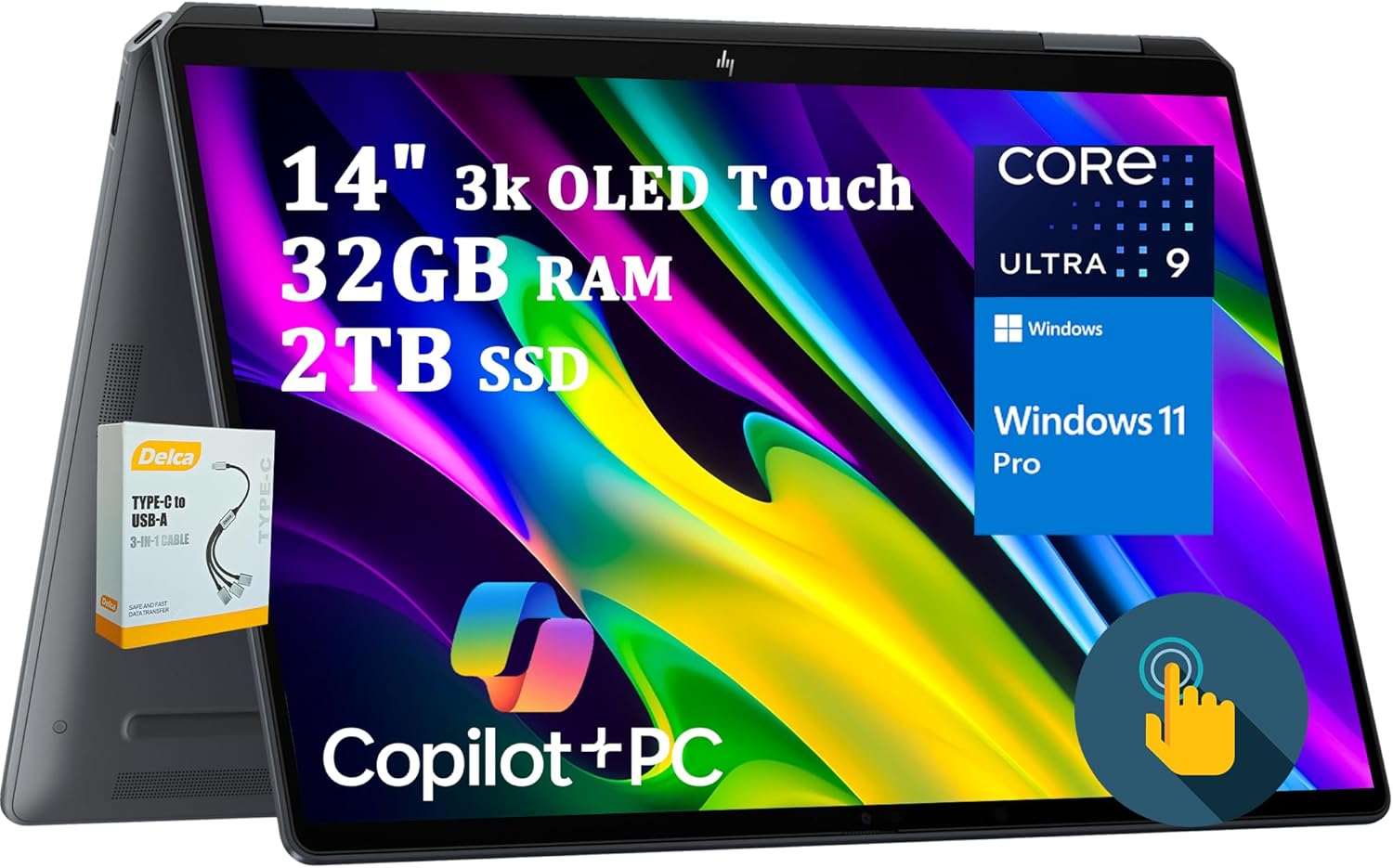
The HP OmniBook Ultra Flip is made for the upcoming AI-laptop wave, featuring high-quality graphics and powerful hardware. The 14-inch 3K (2880×1800) OLED touchscreen has a 120Hz refresh rate, 500 nits brightness, and 100% DCI-P3 color, so everything looks sharp, bright, and smooth. Inside is an Intel Core Ultra 9 288V (8-core) with up to 48 NPU peak TOPS, paired with 32GB DDR5 RAM and a massive 2TB SSD. It becomes a powerful, travel-ready 2-in-1 for business, content, and creativity when you add Thunderbolt 4 connections, a fingerprint reader, and a 9MP IR AI privacy camera.
7. HP Spectre x360 2-in-1

People who want a high-end 2-in-1 that can accomplish a lot of things should get the Spectre x360. This 2024 model has a 14-inch 2.8K touchscreen with Intel Evo performance. It is powered by an Intel Core Ultra 7 155H (which has 16 cores) and Intel Arc graphics. It has 32GB of LPDDR5 RAM and a 2TB SSD, so it will stay speedy even when you have a lot of heavy tabs, meetings, and creative tools open. You also get current features like a fingerprint reader, Wi-Fi 6E, Thunderbolt 4, and a backlit keyboard. If you want premium looks plus real horsepower in a flip design, the Spectre is a standout.
8. Samsung Galaxy Book4 Pro

The Galaxy Book4 Pro from Samsung is a laptop with a huge touchscreen that is good for work and entertainment. The 16-inch 3K AMOLED touchscreen (2880×1800) has a fast 120Hz panel that makes everything from spreadsheets to streaming look great and move smoothly. The Intel Core Ultra 7 processor with Intel Arc graphics provide it power. This listing also comes with a large 1TB SSD for projects and files. Samsung also talks about the quad speakers tuned by AKG with Dolby Atmos, which is very important if you edit, present, or consume material on the fly. This is one of the more interesting possibilities if you want a big, high-end display with touch.
9. ASUS Zenbook DUO

The Zenbook DUO is all about multitasking: it has two 14-inch 16:10 OLED touch panels that make your workplace up to 19.8 inches bigger. Each panel has a resolution of 2880×1800 and a refresh rate of 120Hz. It also has a peak brightness of 500 nits in HDR mode, Pantone certification, and 100% DCI-P3 color. So, it’s not just extra screen; it’s fantastic screen. The Intel Core Ultra 9 285H, Intel Arc graphics, 32GB LPDDR5x RAM, and 1TB PCIe SSD all work together to make this computer quite powerful. You may use it as a portable studio for editing, coding, or running several apps at once if you add the detachable Bluetooth keyboard and built-in kickstand.
10. ASUS ProArt P16 AI Creator
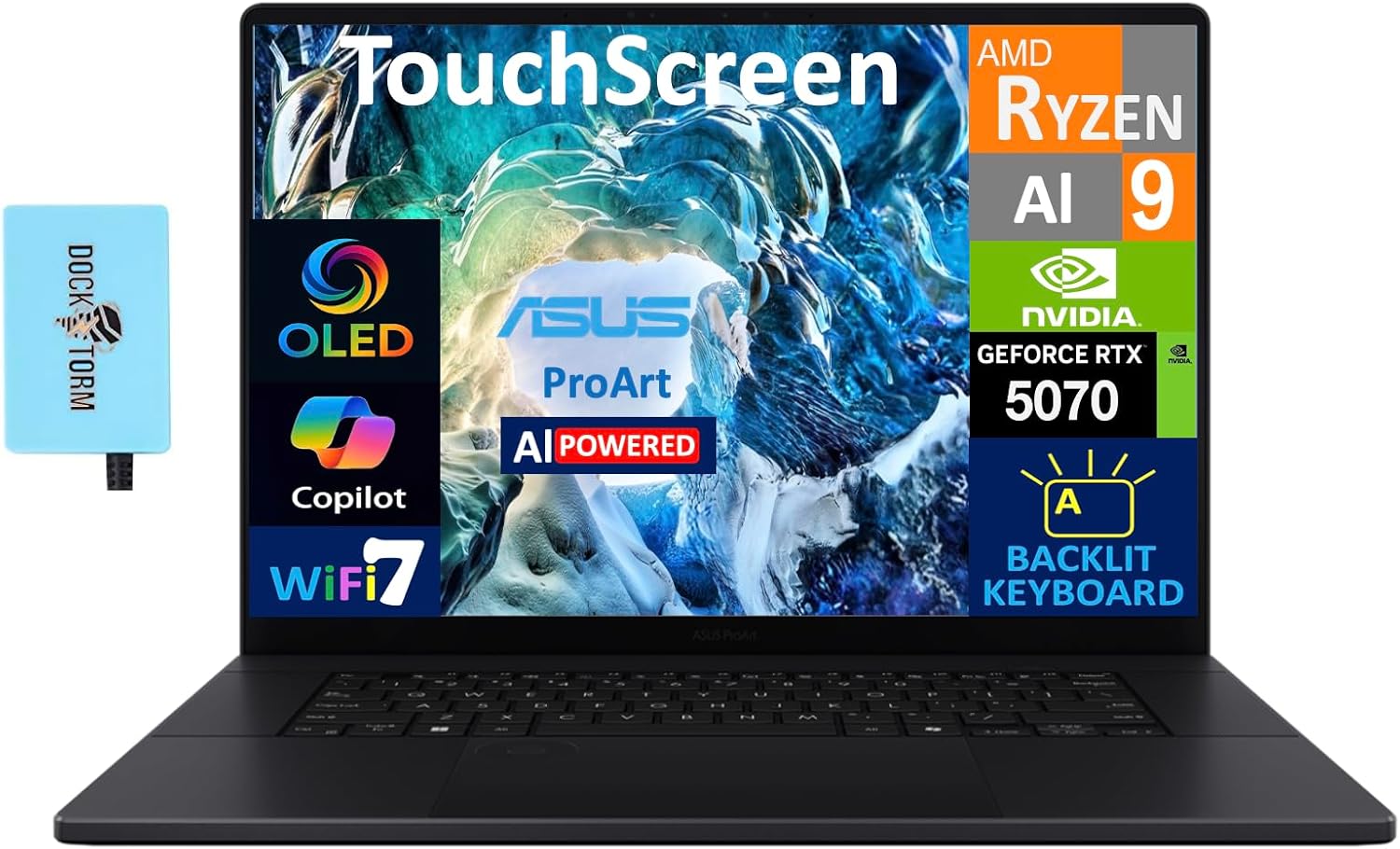
The ProArt P16 is a powerful touchscreen computer made for creators who need to do a lot of editing and design work. It has a 16-inch 4K OLED touchscreen (3840×2400) that runs at 60Hz. It also has an AMD Ryzen AI 9 HX 370 processor (up to 5.1GHz, 12 cores/24 threads) and an NVIDIA GeForce RTX 5070 graphics card with 8GB of GDDR7 memory. This setup has 32GB of RAM, a 2TB PCIe NVMe SSD, and a big 90Wh battery, so you can work on big projects quickly and with a lot of space. It even comes with a USB hub, which makes it a great creative apparatus for 2026 for both home and travel.
11. acer Swift 14 AI Portable Laptop
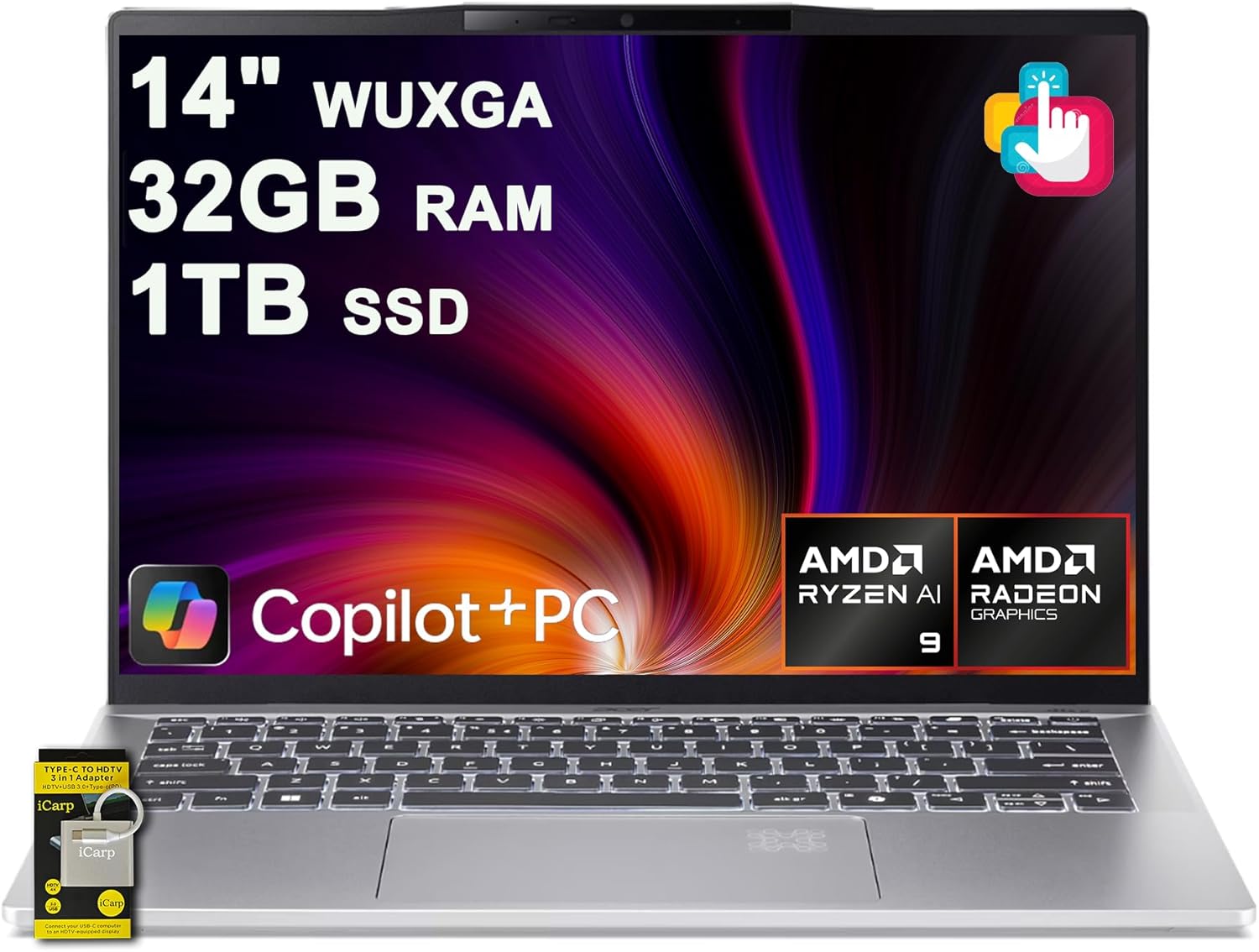
The Acer Swift 14 AI is for consumers who desire modern “AI PC” performance without having to carry about a brick. You receive a 14-inch WUXGA (1920×1200) matte touchscreen, an AMD 10-core Ryzen AI 9 365 processor, 32GB of RAM, and a speedy 1TB SSD. The Radeon 880M graphics card handles creative programs and light gaming well, and Wi-Fi 7 keeps everything running seamlessly online. There are a lot of ports to choose from, including two USB4 Type-C, two USB-A, and HDMI. It’s a good choice for students, creators, and mobile professionals.
12. Lenovo Yoga 7i 2-in-1

As soon as you open the Lenovo Yoga 7i, it feels like a high-end 2-in-1. The 16-inch 2.8K OLED display with a 120Hz refresh rate makes navigating, sketching, and binge-watching look so fluid and sharp. An Intel Core Ultra 7 155H, 16GB of RAM, and a 1TB SSD work together to make routine tasks run quickly, while newer Windows functions run even faster thanks to AI acceleration. With Thunderbolt 4 compatibility, a backlit keyboard, and a hinge that lets you change the shape of the notebook, you have a laptop that can do everything. It works just as well in laptop, tent, or tablet form.
13. Lenovo Yoga 9i 2-in-1

The Yoga 9i is a great choice if you want a small flagship that feels like a high-end device. It has a current Intel Core Ultra 7 processor, a bright 14-inch 2.8K OLED display, a huge 32GB of LPDDR5X RAM, and a 1TB SSD, so you can easily do more than one thing at once. The 2-in-1 design makes it great for taking notes, drawing, or giving a presentation, while Wi-Fi 7 keeps cloud work speedy. It’s the kind of gadget that works for both travelers and artists. It’s portable, powerful, and beautiful, and you can go from typing to touch in seconds.
14. Lenovo ThinkPad X1 2-in-1 Gen 9

The ThinkPad X1 2-in-1 Gen 9 is a powerful tool for doing real work. It has a 14-inch touchscreen and can be used as a tablet or a laptop. It preserves the ThinkPad feel—durability, security, and that famous keyboard—while adding tablet-like ease. This setup has an Intel Core Ultra 7 processor, 32GB of DDR5 RAM, and a large 2TB SSD for intense multitasking and large project files. You also receive a Full HD RGB+IR camera that makes calls clearer, and a pen for meetings, notes, and quick sketching. This is the best 2-in-1 for business that will last.
15. Lenovo ThinkPad P1 Gen 7 Workstation

Do you need a workstation with a touchscreen that can do a lot of things? The ThinkPad P1 Gen 7 is made for engineers and creators who need a lot from their computers. This model comes with an Intel Core Ultra 9 185H vPro processor, NVIDIA RTX 3000 Ada graphics (8GB), 64GB LPDDR5X memory, and a fast 2TB PCIe Gen4 SSD. These are all great specs for 3D work, video editing, and heavy professional software. The 4K OLED touchscreen is 16 inches wide and supports 100% DCI-P3 color and Dolby Vision, so the pictures are clear and bright. It’s not a “cheap” choice, but it’s worth it for professional work.
16. Dell XPS 15 9520

The Dell XPS 15 is still one of the best “power + premium” touchscreen computers. With a 15.6-inch 4K OLED touchscreen with an anti-reflect finish and 400 nits of brightness, this setup makes everything look clear and like a movie. Inside, it has an Intel Core i7-12700H processor, 32GB of DDR5 RAM, a 1TB NVMe SSD, and NVIDIA RTX 3050 Ti graphics. This is perfect for those who want GPU acceleration without getting a full gaming laptop. It’s stylish, powerful, and perfect for folks who want a high-end Windows PC.
17. Dell XPS 9315 Detachable 2-in-1

The XPS 9315 Detachable is a flexible choice for people who want the freedom of a tablet but still require a true PC. It has a brilliant 13-inch 2880×1920 touchscreen with an Intel Core i7-1250U, 16GB of RAM, and a 512GB SSD. This makes it easy to use every day and portable. The fact that it can be taken apart makes it great for traveling, taking notes, or working in small environments like cafés and planes. It’s great for presentations and touch-first workflows where you need something stronger than a basic tablet but lighter than a complete laptop.
18. Dell Inspiron 14 2-in-1 7445

The Inspiron 14 2-in-1 is a useful all-around device that gives you a lot of options without costing a lot. It has a 14-inch WUXGA (1920×1200) touchscreen in a 16:10 shape that works better for work. It also has a hinge that lets you use it as a laptop, tent, or tablet. The AMD Ryzen 5 8640HS processor, 16GB of DDR5 RAM, and 512GB SSD provide enough power for school, business, and everyday content creation. You also get Wi-Fi 6E, a lot of USB-C and USB-A ports, HDMI, and a 1080p webcam that makes calls clearer.
19. HP 2025 OmniBook 5

The HP OmniBook 5 is for folks who desire a huge screen for work and current performance under the hood. This 16-inch WUXGA touchscreen laptop runs an Intel Core Ultra 7 255U processor and comes configured with 16GB DDR5 memory and a 1TB NVMe SSD, which is a strong combo for multitasking and work-from-anywhere tasks. It also has useful additions like a backlit keyboard with a number pad, USB-C with DisplayPort connectivity, and HDMI 2.1 for quick setups with external monitors. This laptop has a large touchscreen and is ideal for daily use.
20. Acer Aspire 3 Spin 14 2-in-1

The Aspire 3 Spin 14 is a cheap 2-in-1 that nevertheless has all the features that most people need. The touchscreen is 14 inches wide and has a WUXGA (1920×1200) resolution. It has a hinge that lets it flip into tablet form for browsing, taking notes, or viewing videos in tent mode. It has a 13th Gen Intel Core i5-1334U processor, 16GB of RAM, and a 512GB SSD, which is a surprisingly good deal for the price. For students and home users, this is a great bargain choice because it has Wi-Fi 6, good ports, and a plain, everyday look.
Things to Consider Before Buying a Touchscreen Laptops
Laptops with touchscreens can transform how you work and play, so you should evaluate screen clarity, touch responsiveness, hinge design, battery impact, build quality, and software compatibility. Consider whether stylus support, glare, weight, and repairability match your workflow, and balance performance and battery life against cost.
Convertible Laptops
You’ll find convertibles like the HP Spectre x360 and Lenovo Yoga offering true 360° hinges, letting you use pen input in tablet mode and a full keyboard in laptop mode; typical weights fall between 1.2-1.6 kg, many sport UHD or FHD touch panels and active-pen protocols, and real-world battery life often ranges 8-12 hours depending on panel resolution and CPU; if you need a versatile device for meetings and sketching, convertibles are a strong choice.
Traditional Laptops with Touchscreen
You get a clamshell laptop with touch added-examples include the Dell XPS 13 and Microsoft Surface Laptop-so you retain rigid chassis, better cooling, and full-size keyboards; screens are usually 13-15″, offering 10-14 hours of battery in efficient models, while touch improves navigation and occasional sketching but rarely replaces a dedicated pen-first workflow.
You should weigh pros and cons: traditional touch models tend to have lower weight penalties than convertibles, maintain larger trackpads (important for productivity), and often use matte or anti-reflective coatings less affected by fingerprints; enterprise variants may include TPM, IR cameras, and MIL-STD testing, so if you use your laptop for heavy typing, long sessions, or business apps, a clamshell touchscreen often gives the best balance of performance and everyday usability.
Processor and Performance
For everyday multitasking you’ll be fine with quad-core or six-core CPUs-Intel Core i5/i7 (11th-13th gen) or AMD Ryzen 5/7-while Apple’s M-series chips offer strong efficiency and single-thread gains; heavy video editing or compiling benefits from 6-8+ cores. Integrated GPUs handle office tasks, but choose a discrete GPU (e.g., NVIDIA GeForce RTX 3050/4050) if you render, game, or run ML models. Pay attention to TDP, power profiles, and cooling because a 45W P-series processor will sustain higher clocks than a 15W U-series even if peak benchmarks look similar.
Advantages
You get immediate, tactile control for tasks like zooming maps, annotating PDFs and sketching-devices such as Surface and Dell XPS 2-in-1s offer active-pen support with ~4096 pressure levels and sub-10 ms latency on modern pens, which speeds workflows for note-taking and concept sketches, and the tablet/convertible form factors give you presentation flexibility in meetings or classrooms.
Disadvantages
You should expect trade-offs: touchscreens often add 100-300 g, push price up about 10-20%, and can cut battery life roughly 10-20% depending on brightness and panel type, while glossy surfaces attract fingerprints and reflect sunlight, making outdoor use harder and increasing maintenance.
In deeper practical terms, accidental palm taps can interrupt precise tasks, and professionals doing CAD or pixel-level editing will still prefer a mouse or dedicated pen with calibration; field workers face glare issues, and because touch is primarily supported on Windows and ChromeOS, you won’t find native touch on macOS-plus any cracked touchscreen repair can quickly approach several hundred dollars.
Researching Options
Use manufacturer spec sheets, plus YouTube tear-downs to verify claims; check measured battery runtimes and color tests. Scan Reddit or model-specific forums for recurring defects like hinge wear or touchscreen calibration drift, and compare street prices across retailers to find realistic discounts versus MSRP.
User Experience
Test multi-touch responsiveness, palm rejection, and stylus latency in person-10-point touch and tilt support matter for drawing and note-taking. Notice refresh rate differences (60Hz vs 120Hz) because higher rates feel smoother, especially when scrolling or sketching. Confirm software compatibility with apps you use (OneNote, Photoshop, Clip Studio Paint) and check driver support for features like tilt and pressure curves.
Try specific models: the Microsoft Surface line provides strong pen latency and detachables ideal for artists, while HP Spectre x360 and Lenovo Yoga offer refined 360° hinges and robust color accuracy for creators. Verify sRGB or Adobe RGB coverage-aim for ≥90% sRGB if color work matters-and test palm rejection by writing fast strokes and resting your hand on the glass. Also inspect hinge stiffness and keyboard travel, since typing comfort influences whether you’ll use the device as a laptop or tablet more often.
Accessories for Touchscreen Laptops
You’ll want to outfit your touchscreen laptop with accessories that match how you use it: USB-C/Thunderbolt docks (40 Gbps) for multi-monitor or external NVMe storage, USB-C hubs with HDMI 4K@60Hz for presentations, tempered glass protectors to reduce scratches and glare, and detachable keyboard covers if you switch between tablet and laptop modes. Choose accessories sized for your model (13″, 14″, 15.6″) to avoid fit and ventilation issues that can raise temps or reduce battery life.
Touchscreen Stylus
If you sketch or take notes you should pick an active pen that supports your laptop’s protocol (MPP, Wacom AES or N-trig). Many high-end pens offer 4,096 pressure levels, tilt detection and sub-20 ms latency for near-natural strokes; examples include Surface Slim Pen 2 and Wacom Bamboo Ink. Prioritize palm rejection, replaceable nibs, and whether you prefer rechargeable pens or AAAA-powered models for longer field use.
Protective Cases
Protective cases come as slim sleeves, folios, hard shells or rugged bumpers; materials range from neoprene and ballistic nylon to polycarbonate. Pick a style that matches travel habits: sleeves add minimal bulk, rugged cases often meet MIL-STD-810G and claim ~1.2 m (4 ft) drop protection. Verify precise dimensions (length, width, depth) and cutouts so ports, vents and hinge movement remain accessible.
When evaluating cases, check for features that matter to touchscreen users: stylus loops or magnetic pen holders, fold-back folios for tablet use, and ventilation cutouts to avoid thermal throttling. Note added weight-sleeves typically add 50-300 g, rugged shells 300-800 g-and thickness, since a tapered ultrabook may not fit a case sized by screen diagonal alone. Brands to trial include Tomtoc, UAG and Pelican depending on protection versus portability needs.
Final Words
With these considerations in mind, you can weigh display quality, portability, battery life, input modes, and performance against your workflow and budget to choose a touchscreen laptop that fits your needs. Prioritize features that improve productivity and ergonomics, test touch responsiveness where possible, and balance build quality with cost so you get long-term value from your purchase.
Leave a Reply